
What is Primary Periodic Paralysis?
Learn about this neuromuscular condition and the path to diagnosis.


PPP overview
Primary Periodic Paralysis (PPP) is a rare condition that impacts your muscles.1 It can cause episodes of muscle weakness or temporary paralysis, often brought on by triggers.
These episodes can begin in childhood or adolescence, typically before age 20.2 Some attacks can begin as early as age 2.
Because PPP is often inherited genetically, people with PPP may have family members who also have PPP symptoms.1
Because PPP is so rare and can be mistaken for other health conditions, it may sometimes take 20+ years to get a diagnosis.2
Over time, uncontrolled PPP may lead to Permanent Muscle Weakness (PMW), which may not go away and can be independent of PPP episodes.2,3 In one study*, they found that PMW can progress in patients with hypokalemic PPP with and without paralytic attacks.3
*Based on a study of 37 adults with HypoPPP that participated in a 3-year follow-up study observing their disease progression.
What causes PPP?
PPP is usually passed down from a parent to a child.1 However, you can still have PPP without an identified genetic connection if you have the signs and symptoms.
-
50%
There is a 50% chance of you having PPP if one of your parents has PPP.1 -
30%
About 30% of people with PPP do not have one of the common genetic mutations associated with it.1
Understanding the signs and symptoms of PPP
PPP causes recurrent and debilitating episodes of muscle weakness and temporary paralysis, negatively impacting your daily life.1,4
PPP episodes can vary in number, severity and length:1
Number of episodes
In some people, episodes happen every day. For others, episodes occur weekly or monthly.
Severity of episodes
PPP episodes may involve weakness that limits some daily activities. More severe episodes can mean complete, but temporary, paralysis.
Length of episodes
Most episodes last a few hours. In some cases, they can last for days.

BEFORE AN EPISODE
Before an episode begins, many people report feeling:4
- Tingling in the hands or feet
- Irritability
- Fatigue
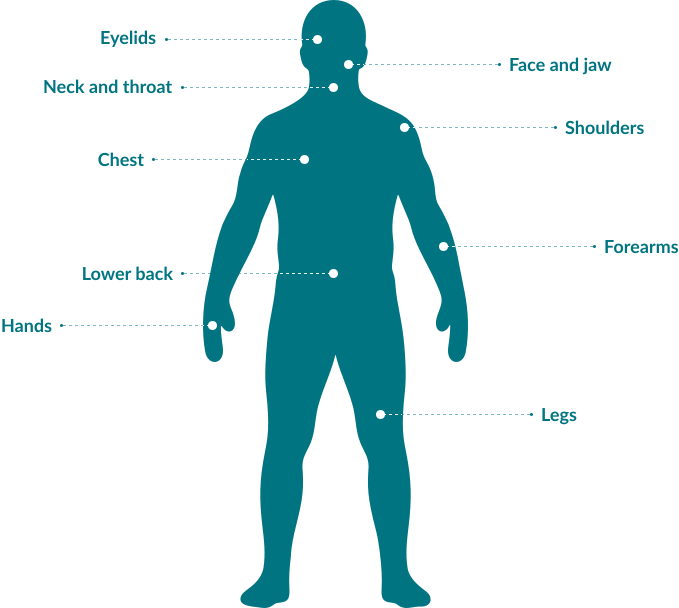
PPP often affects the following muscles:1,4
AFTER AN EPISODE
Certain symptoms that have reportedly appeared after an attack include:4
Clumsiness
Palpitations
Weakness
Extreme fatigue
Pain
“I usually became paralyzed in the middle of the night, so I would have to holler for my mom or sisters to help turn me because I would be in so much pain. I would have total feeling from head to toe, but couldn’t move a thing.”
—Diagnosed PPP Patient

Recognizing PPP’s impact
The burden of PPP episodes is not only physical. Weakness, loss of energy and stiff muscles can limit your ability to engage in activities with friends and family, resulting in a serious impact on your emotional state.1,4
-
Stress and social anxiety4
Often, you may experience stress and social anxiety about having an episode. You may worry about how others perceive you during an episode. This can lead to a cycle of continued stress, often triggering or worsening an episode. -
Permanent Muscle Weakness (PMW)
PPP can also lead to PMW. PMW is weakness that does not go away and isn’t associated with any specific PPP episode.2,3 It can limit your ability to move, impacting your work, social, and family life.- In one survey, more than 60% of people with a history of PPP said that they had PMW.2*
*Based on a survey of 66 self-selected patients over the age of 40 years with a clinical diagnosis of Primary Periodic Paralysis who sought support via the internet. Permanent muscle weakness was defined as muscle weakness which is always present and varies little from day-to-day.

The different types of PPP
There are several subtypes of PPP. What makes them different is the level of potassium in your blood during the episode, what happens during the episode, what triggers it, and which genes are involved.1,5,6
All types of PPP cause muscle weakness that can impact several parts of the body.1,4
Hypokalemic (~1 in 100,00)1,5,6
PPP episodes may involve a decrease in potassium levels.
- Typically manifests as attacks of weakness that can last for hours
- During attacks, potassium levels decrease due to potassium shifting from the bloodstream to the skeletal muscle
Hyperkalemic (~1 in 200,000)1,4-6
PPP episodes may involve an increase in potassium levels. In some cases, potassium levels are normal during an episode.
- Typically manifests as attacks of weakness that can last for minutes to hours
- During attacks, potassium levels are elevated due to potassium shifting from the muscle to the bloodstream. Sometimes serum potassium levels can remain normal
Paramyotonia Congenita (<1 in 100,000)4,7
PPP episodes may involve normal or elevated potassium levels during an episode
- Typically manifests as sustained muscle tensing that prevents muscles from relaxing. Attacks can last for hours
- During attacks, potassium levels in the bloodstream can be elevated or normal
Andersen-Tawil Syndrome (ATS) (1 in 1 million)1*
- Typically manifests as attacks of weakness that can last for hours
- During attacks, potassium levels in the bloodstream can be high, low, or normal
- Characteristics of ATS include muscle weakness, changes in heartbeat, and distinct skeletal features
*Patients with ATS were not included in clinical trials for KEVEYIS

triggers
What can trigger a PPP episode?1,4
PPP episodes can happen at any time — but they’re usually brought on by a trigger. Common triggers across the four PPP types may include:
- Certain foods that have a lot of potassium or carbohydrates
- Stress
- Exposure to cold or becoming chilled
- Alcohol
- Resting after exercise
Triggers can vary depending on your specific PPP diagnosis, as well as other factors.


DIAGNOSIS
The path to a PPP diagnosis
Because of how rare PPP is, it can be challenging to receive an accurate diagnosis. Your symptoms may be confused for those of more common conditions, like mental health disorders such as depression.1,4
If PPP is suspected, your doctor may review your medical history and your family’s medical history, then perform a physical exam and blood tests.1 Your doctor may also recommend:
- Genetic testing
- Electrocardiogram (EKG)
- Electromyography (EMG)
- Compound muscle action potential (CMAP)

References
- Statland JM, Fontaine B, Hanna MG, et al. Review of the diagnosis and treatment of periodic paralysis. Muscle Nerve. 2018;57:522-530.
- Cavel-Greant D, Lehmann-Horn F, Jurkat-Rott K. The impact of permanent muscle weakness on quality of life in periodic paralysis: a survey of 66 patients. Acta Myol. 2012;31:126-133.
- Holm-Yildiz S, Krag T, Witting N, et al. Hypokalemic periodic paralysis: a 3-year follow-up study. J Neurol. 2023;270(12):6057-6063. doi:10.1007/s00415-023-11964-z
- Charles G, Zheng C, Lehmann-Horn F, Jurkat-Rott K, Levitt J. Characterization of hyperkalemic periodic paralysis: a survey of genetically diagnosed individuals. J Neurol. 2013;260:2606-2613.
- Cannon, SC. Channelopathies of skeletal muscle excitability. Compr Physiol. 2015;5(2):761-790.
- Ralph J, Ptacek L. Muscle channelopathies: periodic paralyses and nondystrophic myotonias. In: Rosenberg RN, Pascual JM, eds. Rosenberg’s Molecular and Genetic Basis of Neurological and Psychiatric Disease. 5th ed. Elsevier; 2015:1177- 1189.
- Paramyotonia Congenita. MedlinePlus. Updated August 1, 2015. Accessed June 10, 2025. https://medlineplus.gov/genetics/condition/paramyotonia-congenita/